The Book: The First Monograph on Jocelyne Saab's Work
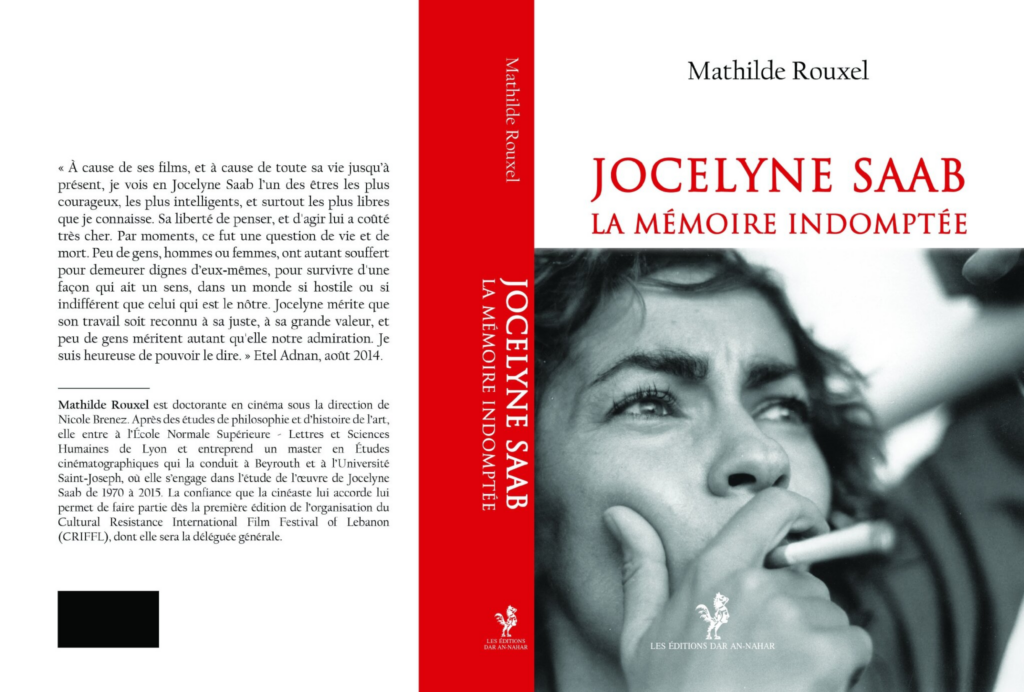
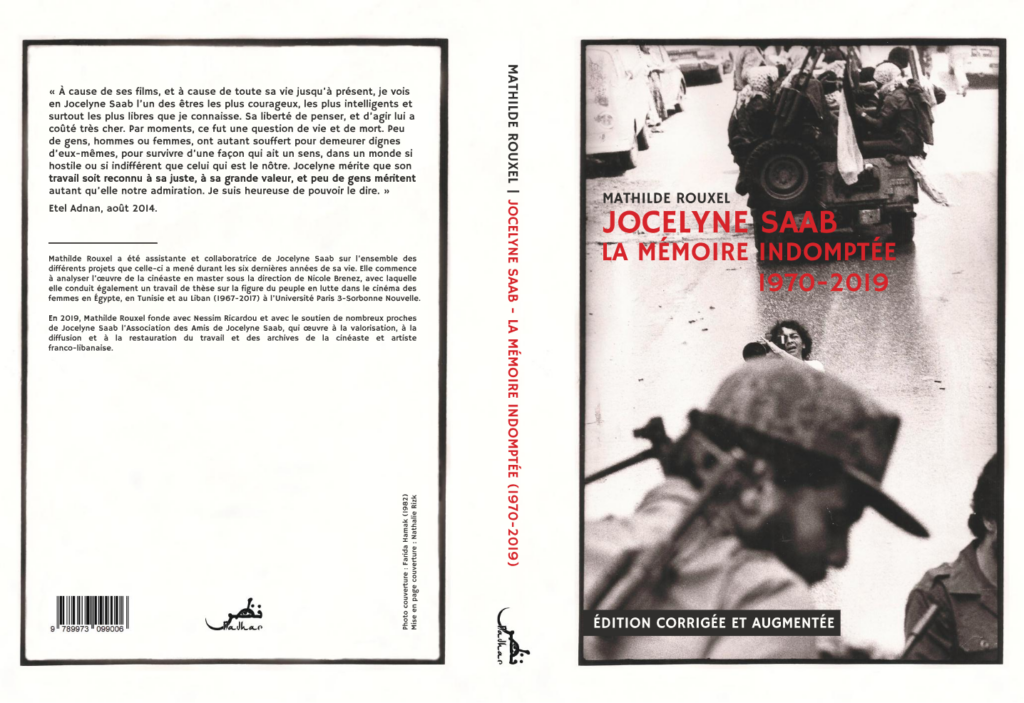
Published in 2015 by éditions An-Nahar,Jocelyne Saab, la mémoire indomptée (The Untamed Memory) is the first monograph entirely dedicated to the Franco-Lebanese filmmaker and photographer. Written byMathilde Rouxel during her research at the École Normale Supérieure de Lyon and under the supervision of Nicole Brenez, this volume offers the first in-depth study of the entire artistic production of Jocelyne Saab between 1970 and 2015.
The book draws on the trust that Jocelyne Saab placed in Mathilde Rouxel, allowing her unprecedented access to the filmmaker's archives. This collaboration led Rouxel to become involved in the organization of the Cultural Resistance International Film Festival of Lebanon (CRIFFL), of which she later became the general delegate
An Analytical and Chronological Approach
The volume presents a collection of aesthetic analyses, preceded by a detailed chronology of Jocelyne Saab's journalistic, cinematic, and artistic productions from 1970 to 2015.
Jocelyne Saab was born in 1948 in Beirut. A large part of her filmography, in both documentary and fiction, is devoted to the destruction of her country, Lebanon, during the civil war that tore it apart for fifteen years. She covered most of the wars in the Middle East, then turned to Egypt and Vietnam, while working towards the creation of a Lebanese cinematheque and a festival dedicated to Asian cinemas.
The book traces this journey: from her early work as a war correspondent in 1973 covering the October War for French television, to her first feature-length documentaryLe Liban dans la tourmente (1975), her coverage of the siege of Beirut in 1982 (Beyrouth ma ville), her documentaryLa Dame de Saïgon (1997) shot in Vietnam, and her fiction films includingUne vie suspendue (1985, selected for the Quinzaine des Réalisateurs at Cannes) andDunia (2005, which earned her a death threat from Egyptian fundamentalists).
A Polymorphic Body of Work
The monograph highlights the diversity of Jocelyne Saab's practice: beyond cinema, she also led a parallel activity as a visual artist from 2007, creating installations, mixed-media works, and photography. The book emphasizes the poetic and political gesture of an unclassifiable filmmaker over more than forty years of creation.
Foreword by Jocelyne Saab (2015):
Memory Under the Bed by Jocelyne Saab (2015)
When a young graduate in philosophy and art history, then a film student at the ENS de Lyon, Mathilde Rouxel, came to see me in Beirut during the summer of 2013 to study my film work, bombs were exploding on every street corner. She didn't seem concerned and insisted on meeting me; an interview conducted by Guy Hennebelle in 1975, published on the occasion of the theatrical release in Paris ofLebanon in Turmoil, my first feature-length documentary, had caught her attention. My audacity had apparently intrigued her. A second, more recent interview with Olivier Hadouchi would guide the first steps of her research.
I was then in the midst of preparing the Cultural Resistance Film Festival, which I was putting together from scratch to react to the heavy political and social situation into which the country had once again sunk. In the urgency to act, I offered her to accompany me in this endeavor, thereby giving her a chance to understand a little of the country and my reasons for acting as I did. By following me in this adventure, she was able to discern what motivated my commitment, and she was able to find in my films, my photographs, and my videos those lines of force that run from one end to the other through my work as an artist. Mathilde Rouxel was barely 21 years old at the time and proved to be a precious collaborator.
After this exhilarating experience, whose objective was to "heal the wounds [of a city at war] on the big screen," Mathilde threw herself headlong into my work, into my images, in search of what she identified as my "tenacious will to rebuild a disappearing memory, to express an impossible truth to recapture, […] guided by this inner search for an identity that justifies her place and role in a world that is tearing itself apart and plunging into oblivion."
I was then living in Ain Mreisseh, at the top of the city's most advanced point on the sea, in a small room on a rooftop lent by a couple of patron friends. In this little shack with its romantic appearance, the only space I had to store my films was a large wooden bed under which I slid heavy metal trunks full of my memories.
In this country drowned in contradictions, where your personality is judged only according to the money you have and your oligarchic and family ties, achievements, performances, or human values are underestimated, even scorned. I nonetheless maintained the illusion that these metal trunks could protect a life experience made of authenticity, human adventures, and passion, which constituted, profoundly, my identity. It took me months to find the courage – psychological more than physical – to lie down on the floor in that cramped space and slip under the bed to pull out, one by one, the video cassettes of my films, the reels of film, the DVDs, to entrust them to Mathilde. I had no idea that she would succeed so well in bringing forty years of testimony back to life.
What touched me most in reading this first monograph, where Mathilde, as Nicole Brenez says, revisits my way of exalting art in the documentary, is the subtlety with which she was able to see, beyond the simple documentary information, balanced by the explosive subjectivity that characterized me; she was able to grasp what had tormented me throughout my career in my capture of images: the search for a "narrative pact established between the camera and the real world" born first from human contact, from a benevolent gaze. It is a definition that has always been denied to me – whether I film Beirut in the midst of civil war or approach sacred taboos through fiction as withDunia in Egypt, I have often been made out to be a banal gargantuan witch, because of the unforeseen impact of my films on society. Yet I am no taller than three apples, but always ready to brave the fire; didn't Pasolini write: "Making cinema is writing on paper that burns"? I have thus become, thanks to this – lucid – reading of my films, what I have always been: a woman committed to the right to life through images.
Mathilde Rouxel, through this book, has contributed to the creation of a working tool, essential for updating a part of the collective memory of a country still in denial of its past.
I thank Nicole Brenez for having asked Mathilde Rouxel to devote an exhaustive monographic study to me, and the persevering publisher of Dar an-Nahar, Jana Tamer, without whom this book would not have existed.
Press coverage :
Colette Khalaf, « Sortir ces films-témoignages, et Jocelyne Saab, de leur cachette sous le lit », Interview with Mathilde Rouxel,L'Orient-Le Jour, 27 octobre 2015.
🔗 https://www.lorientlejour.com/article/951491/sortir-ces-films-temoignages-et-jocelyne-saab-de-leur-cachette-sous-le-lit.html
“#MOE : Jocelyne Saab, Ourida Nekkache, Agnès Carayon”, Maghreb-Orient Express, TV5 Monde, 12 décembre 2016 : https://www.youtube.com/watch?v=dWczXFUvJbg
Critical and Editorial Context
Jocelyne Saab, la mémoire indomptée is the first monograph devoted to the filmmaker's work. Its introduction was later adapted and translated for the English-language volumeReFocus: The Films of Jocelyne Saab published in 2021.[b]