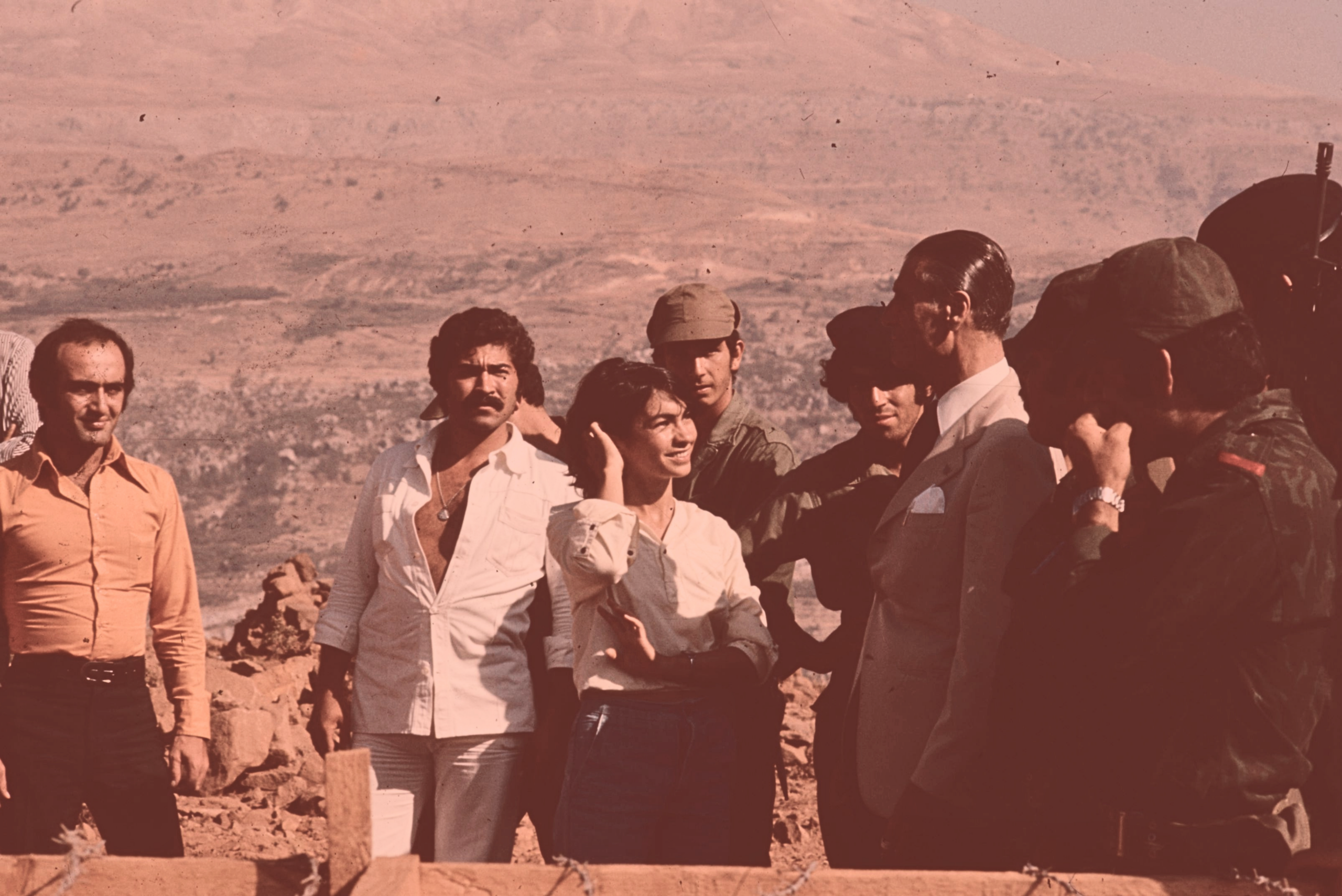
In the early 1970s, Jocelyne Saab entered the world of images through journalism. After studying political economy in Beirut and Paris, she became a journalist for Lebanese radio and television, and then a war reporter for French television. In a regional context marked by Arab independence, the rise of resistance movements and the Cold War, she embraced reporting as a way of observing the profound transformations taking place across the Arab countries..
As a native Arabic speaker, Jocelyne Saab was sent by the ORTF to Egypt, Syria, Iraq, Libya and Palestine to cover the conflicts and political crises affecting the region, such as the October 1973 war: this gave her the opportunity to film these events from an insider’s perspective, offering an alternative to the usual Western news coverage. It was during this period that Jocelyne Saab chose to work in direct contact with the situations and communities she was covering. From her very first reports, she aimed not only to report the news, but also to understand the human stories caught up in the upheavals of history.
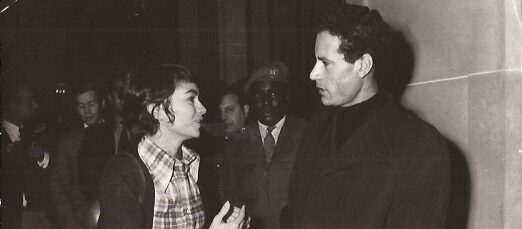
His focus gradually turns to those marginalised by the dominant narratives: refugees, combatants, women, children and civilians. Political events are thus never separated from the everyday experiences of those living through them.
This approach would shape his entire body of documentary work: giving a voice to those who have been forgotten, filming the tangible consequences of conflicts and power relations, and embedding individual stories within a collective memory.
From 1973 onwards, Jocelyne Saab became involved with the Palestinian resistance movements and produced documentaries devoted to them, including Les Palestiniens continuent (1973) and Les Femmes palestiniennes (1974). These films reflect her involvement in the internationalist and emancipatory struggles emerging across the world, as well as her determination to move beyond simplistic portrayals of conflicts. Indeed, she filmed the Palestinian resistance to highlight the lives, aspirations and contradictions that define it.
Although Les Femmes palestiniennes was censored by the ORTF and would never be broadcast during Jocelyne Saab’s lifetime, her early reports quickly circulated through European television networks, and gradually transforming her approach to image and news journalism.