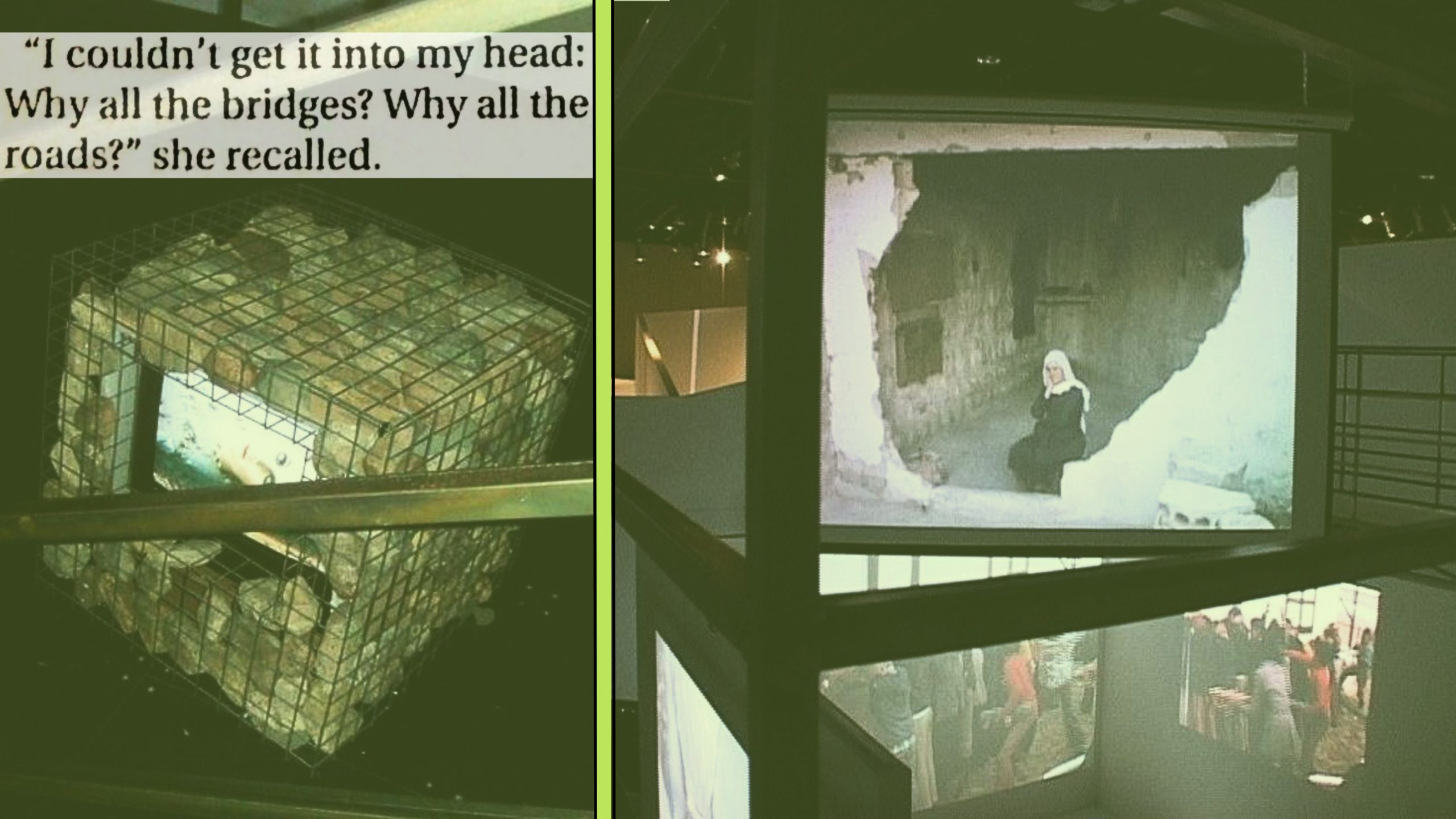
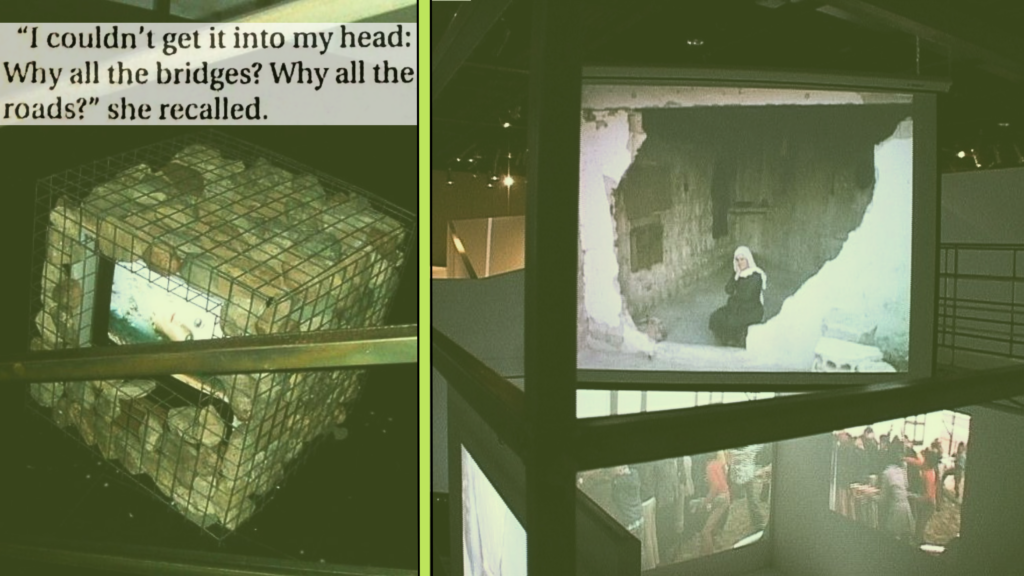
A few months after the release of Dunia, Lebanon was once again bombed by Israel during the summer of 2006. As she had done since the 1970s, Jocelyne Saab picked up her camera again to film the collapsed bridges, the cut-off roads and the landscapes torn apart by war. However, after more than thirty years spent documenting conflicts, she felt the need to shift her work towards other artistic forms: forms that allow audiences to physically experience the images and to construct their own journey through memory.
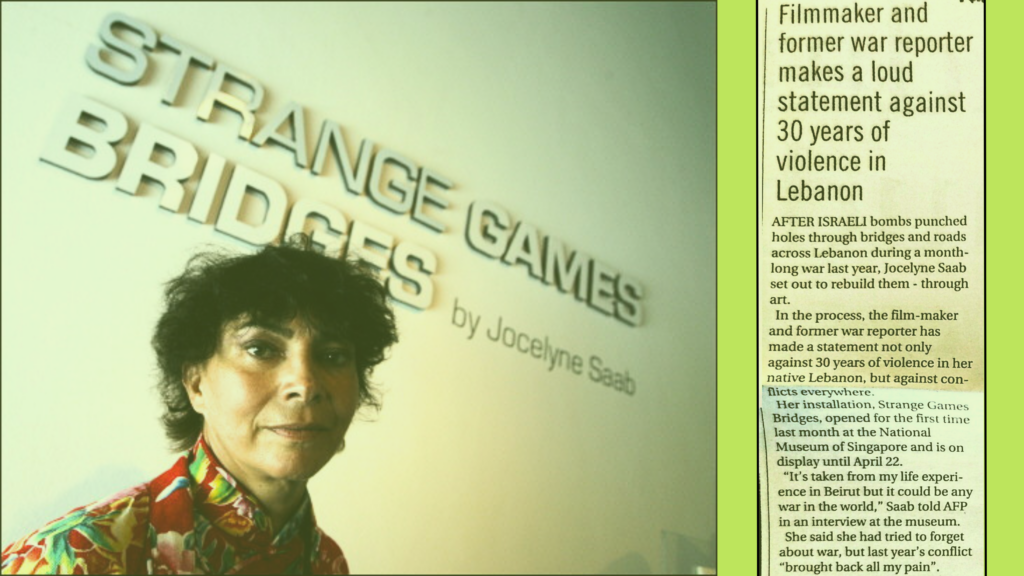
This concept gave rise to the installation Strange Games and Bridges, exhibited in 2007 at the National Museum of Singapore. The work takes the form of a vast hanging garden covering nearly 150 m², spanned by a 42-metre-long metal footbridge. Twenty-two screens simultaneously display the footage she shot during the Lebanese Civil War and that filmed during the 2006 bombings. Jocelyne Saab describes the installation as an ‘archaeological excavation site’ where the destruction of Beirut echoes across time. This work marks a major shift: the narrative is no longer constructed through editing, but by the visitor themselves, who is invited to move between images of the past and those of the present.
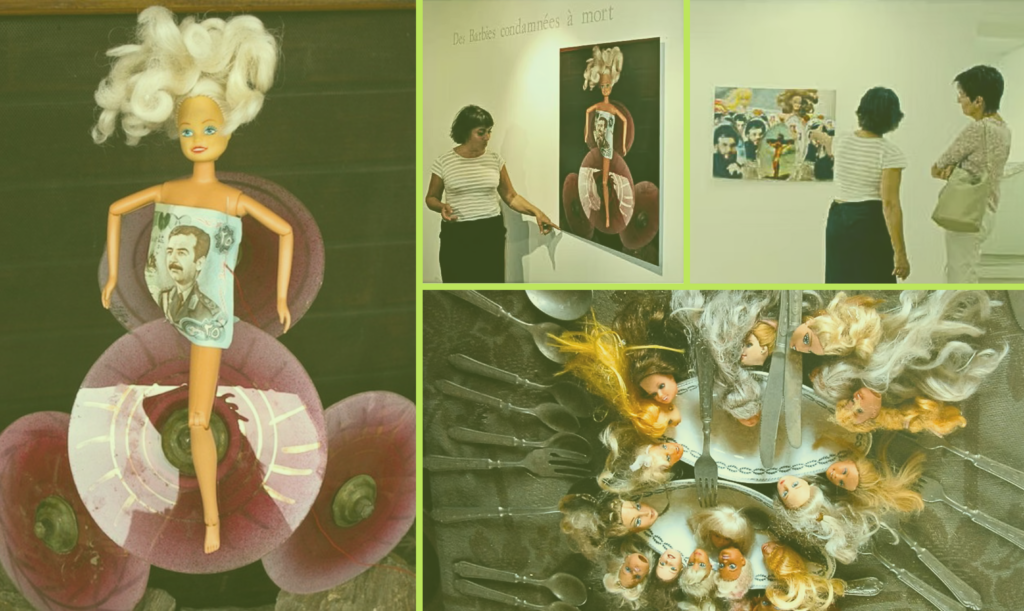
That same year, Jocelyne Saab developed several photographic series, exhibited under various titles in Dubai, Beirut, Tripoli, Paris, Lyon, Brussels and Florence. Among these, the series Le Revers de l’orientalisme (Marilyn and the Arabs / Transmission interrompue) took shape in Cairo, where the filmmaker collected old Barbie dolls from the souks. By photographing them, following in the footsteps of Edward Said, she examines the fantasised images of the West that circulate in certain Arab societies, in order to question imported cultural models and the way in which female bodies remain trapped within contradictory representations.
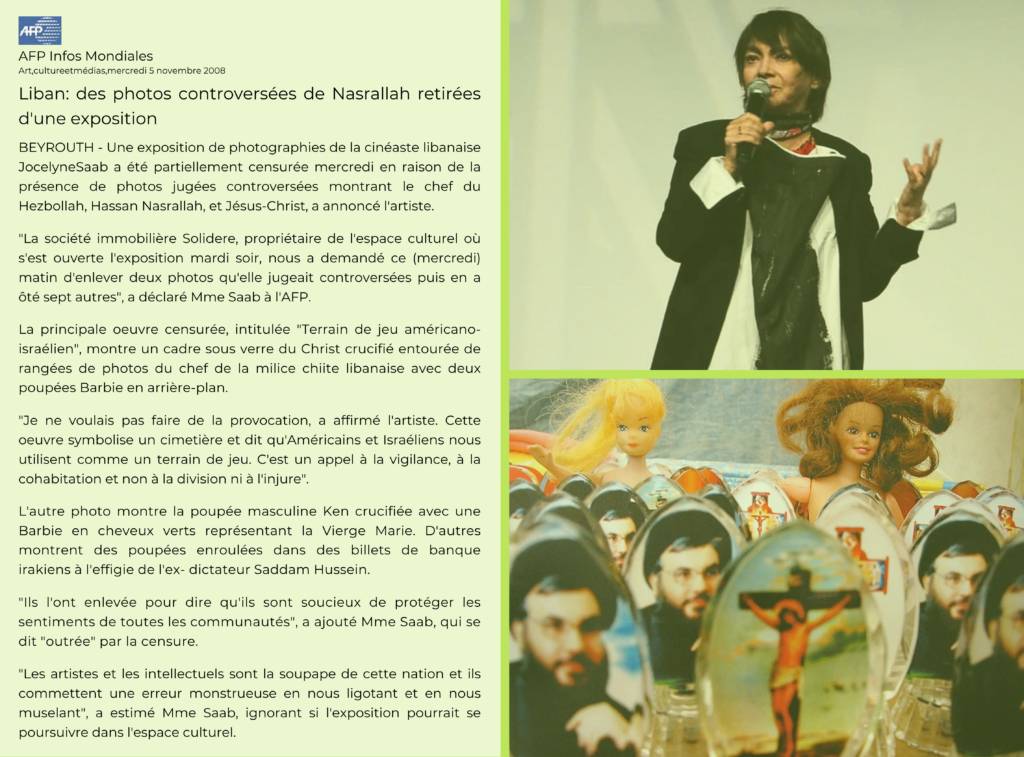
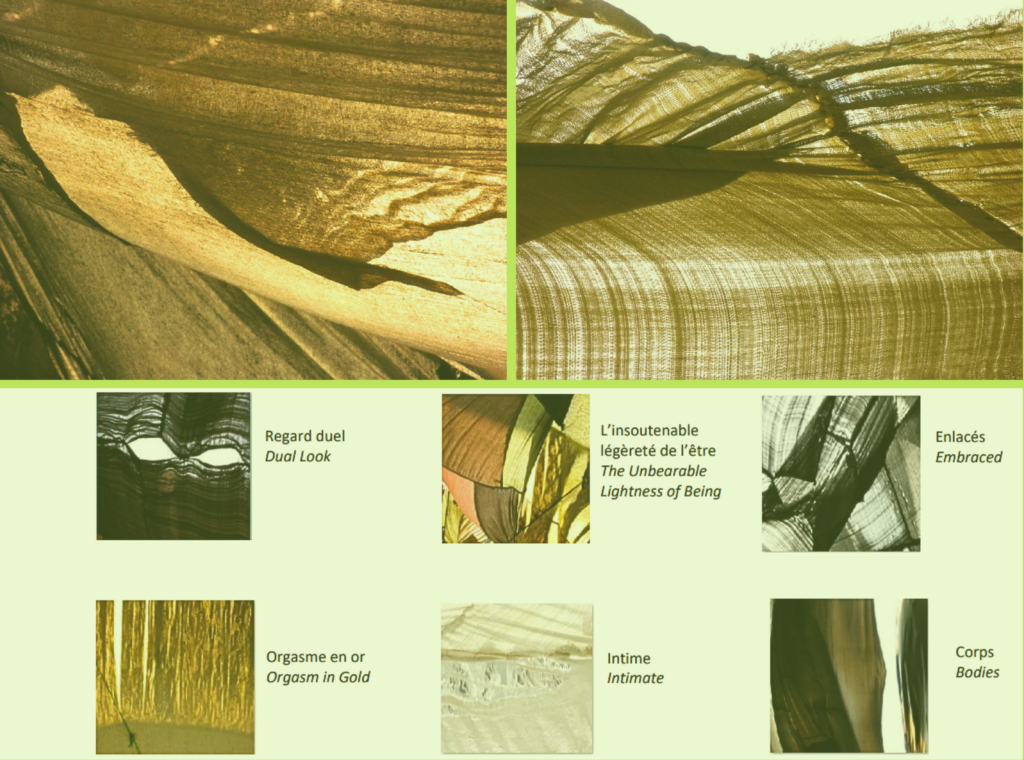
Travelling through the desert, Jocelyne Saab then photographed the fabrics of nomadic tents, the folds of the cloth, the knots and the play of light, thus creating the photographic series Architecture molle. In it, she captures the sensuality inherent in the materials, landscapes and architecture of Arab societies, in contrast to discourses that tend to erase it. Her photographic series, which invite reflection on images, cultural heritage and fragmented memories, were notably exhibited in 2008 at the AGIAL gallery in Beirut under the title Sens, icons and sensitivity. However, some of the images in the exhibition were censored by the local authorities.
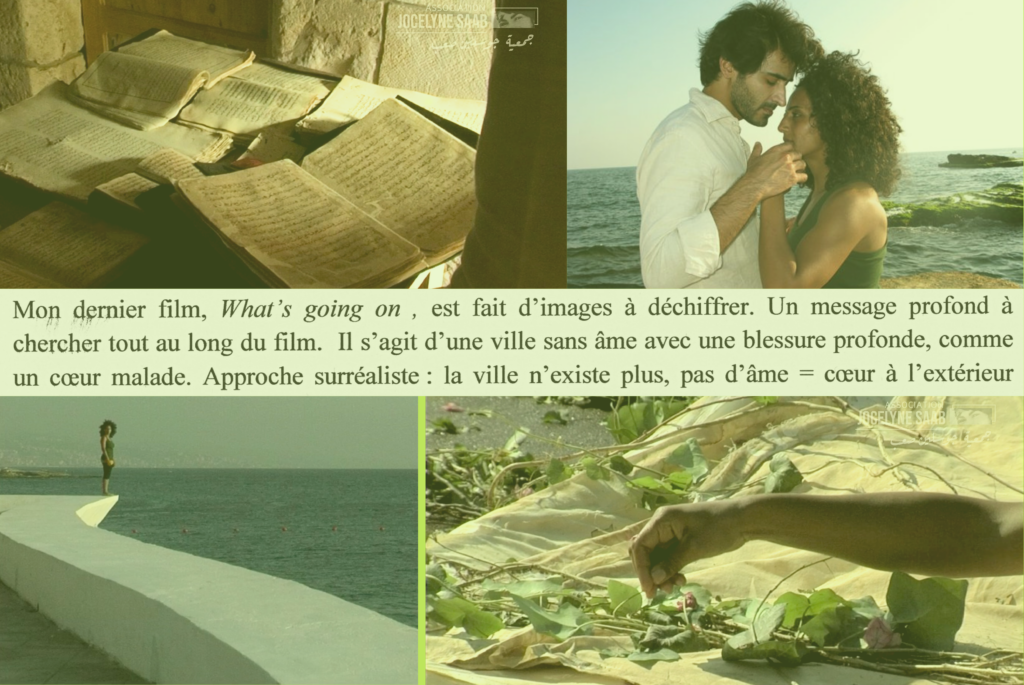
In 2009, Jocelyne Saab directed What’s Going On?, a new feature-length fiction film co-written with Joumana Haddad. The film takes the form of a cinematic essay and is a direct continuation of her artistic exploration begun in 2006: a writer crafts and weaves her texts around the inhabitants of Beirut, before encountering a dancer filmed as a “metaphor to speak of the lost soul of the city of Beirut”. Its fragmentary structure creates a dialogue between literature, dance, architecture and memory, embracing a city whose rapid reconstruction threatens to erase the traces of its history.
In 2013, Jocelyne Saab went on to produce Café du Genre, a series of six video portraits commissioned for the exhibition Au Bazar du Genre. Féminin – Masculin en Méditerranée at the MUCEM in Marseille. In it, she portrays artists, writers, choreographers and activists from various countries — Walid Aouni, Adel Siwi, Wassyla Tamzali, Joumana Haddad, Alexandre Paulikevitch, Cuneyt Cebenoyan and Melek Özman — whose life stories explore the relationships between creativity, gender, sexuality and freedoms. Jocelyne Saab aims to ‘reverse the gaze’ directed at women in the Mediterranean region and to understand ‘how women’s bodies have become a thing, a political object’. This approach directly echoes the research carried out in Les Almées, Dunia and What’s Going On?, and weaves together memories and commitments to map out an alternative cultural geography of the Mediterranean.