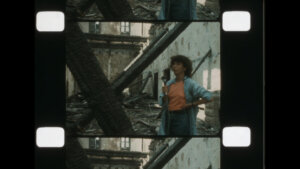
These images were essential to Jocelyne Saab; it is important for us to share them. Witnesses to a vanished world, her films tell the story of Lebanon, its wars, its intimate revolutions, and its shattered hopes. Today, the Jocelyne Saab Association is undertaking a unique endeavor: restoring a rich and varied body of work to make it accessible to the public, researchers, and new generations.
A Body of Work Born in the Urgency of History
When Jocelyne Saab passed away on January 7, 2019, she left behind a cinematic legacy of exceptional richness, yet still too little known. A journalist in Lebanon from 1970, and a war correspondent for French television from 1973, she asserted her independence as a documentary filmmaker in 1974. She made over twenty documentaries, both short and feature-length, in 16mm between 1974 and 1989, ventured into fiction in 1984, and continued to produce documentary films for French television, shot on video in the 1990s. In 2005, after seven years of intense work, she completed her major fiction film Dunia, her first digital work, which was stifled by insidious censorship in Egypt, where it was shot. She then turned to other forms of expression: video art, mixed-media installations, and photography, culminating in her final work, a book of images, Zones de guerre (2018). Throughout her career, one obsession recurs: the images of the Lebanese Civil War, reappearing from one film to another and confronting the present—as in the installation Strange Games and Bridges (2007), where she juxtaposes the Israeli destruction of 2006 with her own images from the 1970s. Essential for the writing of history, her images offer a free and audacious point of view. But having long remained in the shadows, barely accessible and difficult to distribute, they are now generating growing interest.
The Jocelyne Saab Association: Structuring a Legacy
The Jocelyne Saab Association was created to structure the management of the late filmmaker’s artistic legacy. Founded on the initiative of Mathilde Rouxel and Nessim Ricardou-Saab, and bringing together those close to the filmmaker – Michèle Tyan, Jacques Bouquin, Jonathan Randal, Sophie Ristelhueber, Bernard Latarjet, François Hers, Frédéric Beaugendre, Francis Lacloche, Myrna Maakaron, Pascal Truchet, later joined by Jinane Mrad who now co-directs the association with Mathilde Rouxel – the goal was to inventory, gather, restore, and promote Jocelyne Saab’s work. The first task in 2019 was to collect all available copies (Beta Num, Beta SP, miniDV) and digitize them at Lucid Post in Beirut and at Polygone étoilé in Marseille, to make them accessible and enable wider circulation of the films. This work initiated a broad and sustained effort to program the filmmaker’s films around the world, long carried by the Jocelyne Saab Association.
The Challenge: Finding the Originals
An extensive search was undertaken to locate the original film materials. A major portion is preserved at the CNC, where Jocelyne Saab deposited them in the 1990s, but other films were unearthed from personal archives, foreign institutions, or laboratory storage. Sixteen documentaries shot between 1973 and 1982 were found in 16mm, along with five Egyptian short films, and were released in a DVD box set by Les Mutins de Pangée. During the inventory process, we discovered that several films broadcast on French television had actually been re-edited in a way that diluted their political content – the original edits, preserved in Saab’s archives, are more radical. We also recovered, even though Jocelyne herself believed it lost forever, the original version of her first fiction film, Ghazl al-banat (presented at Cannes in 1985 under the title Adolescente, sucre d’amour), which had been shortened for its theatrical release in 1988 under the title Une vie suspendue. A preservation copy was found at the Cinémathèque québécoise and restored in 4K in 2025 by the Association, with digitization generously provided by the Cinémathèque suisse. The original materials for some films (La Tueuse, 1989; La Dame de Saigon, 1997; Il était une fois Beyrouth, 1994) have not yet been located.
A Collective Restoration Process
The trust of Nessim Ricardou-Saab allowed us to work freely on the restoration. Rejecting the idea of restoring the films one by one, the association early on decided to involve Lebanese technicians, trained in the ethical principles of restoration. The work began in July 2020 in Ghent, at the KASK & Conservatorium, where Mohanad Yaqubi hosted the project within his CRAMP research program, enabling the inventory, mechanical repair, and initial 2K scanning of the fifteen films. We welcomed Jean-Philippe Bessas from the INA to train the team in software use. The next step consisted of a series of three workshops in 2021, organized with the collaboration of the International Federation of Film Archives (FIAF) and the Cinematheque Beirut project: an online seminar on restoration ethics, a practical training session at Polygone étoilé in Marseille where Lebanese technicians came to learn the Diamant HS-ART and DaVinci Resolve software, and a final session in Beirut at The Post Office to pass on these skills to a wider team. About ten Lebanese technicians were trained – image restorers, sound restorers, colorists – some of whom have since left Lebanon, driven by the economic crisis. The association purchased a lifetime license for Diamant HS-ART, made available for other non-profit restoration projects. In October 2022, the Cinémathèque suisse hosted the team for an in-depth technical visit. Other technicians joined the team: Manal Zakharia, Vanessa Helou, Margaux Chalançon, and Monzer El Hachem for sound restoration. All were driven by their interest in the filmmaker’s work.
Today: Films Alive and Accessible Worldwide
The entire collection is now available in DCP 2K, with subtitles in Arabic, French, English, and Spanish. The films have been widely screened at festivals, in cinemas, and online. They can be viewed on the Base commune Marseille-monde available on Amorce: https://www.amorce.eu/cinematheques-archives-la-base-commune-marseille-monde-792-22-0-0.html
Digitizing and Depositing Film and Non-Film Heritage in Beirut
Beyond the film archive, the Association has undertaken the digitization of the entire non-film archive (photographs, contracts, unfinished projects) thanks to the meticulous work of Stéphane Moro, Esther Rouxel, and Lucie Ricardou. The originals will be deposited at the Cinémathèque française, but digital versions will be available for consultation at various institutions in Lebanon (Cinematheque Beirut, Nadi Lekol Nas), alongside the films and all digitized and inventoried materials. The goal is to facilitate access to Jocelyne Saab’s archives: lightweight versions of all these digitized archives will be accessible online.
For Distribution, Support, or Participation
For more information on distribution conditions: amicale.jocelynesaab@gmail.com. The Jocelyne Saab Association is also a founder of the Maraya project, a digital restoration laboratory being established in Beirut, equipped with a Cintel scanner and all the digital restoration equipment acquired by the Association. If you have an archive digitization or film restoration project: filmrestoration@jocelynesaab.org